Erwin Wurm (Austria, 1954) is one of the contemporary artists who has most radically rethought and deconstructed the concept of sculpture. He has placed the body and the object at the centre of a reflection and experimentation that goes beyond the boundaries traditionally drawn between art and life.
Humour, irony, and paradox become narrative tools, shedding light on the dynamics of contemporary society, which the artist often critiques for its capitalist pressures and externally imposed constructions of identity.
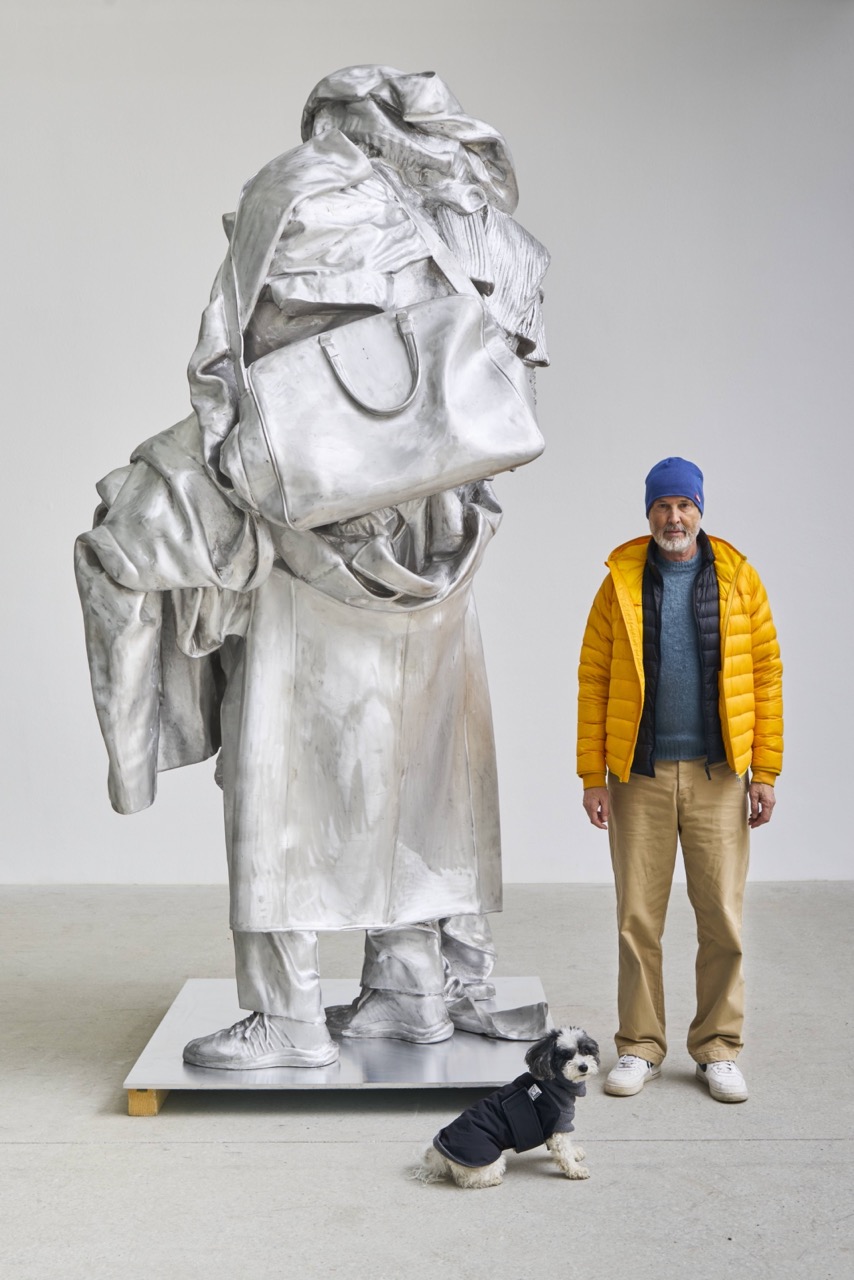
All these elements come together in Balzac, an aluminium sculpture depicting a series of contemporary garments that appear to be worn by someone but are in fact revealed to be devoid of any human presence. Part of the Substitutes series, the work refers to Auguste Rodin’s celebrated Monument to Balzac, which was initially judged to be a formless work, but is now regarded as a masterpiece by the French artist. Wurm takes it as a starting point to offer a different version of the same figure: rather than creating a heroic monument, he explores conceptual plasticity and communicates through irony. And while in Rodin’s sculpture Balzac seems to be becoming one with his coat, in Wurm’s Balzac, only the garments remain to evoke him.
The sculpture thus presents itself as a monument to absence, in which the person has given way to what they wear — a reflection of a society that privileges appearance over being, form over content.
The crossbody bag resting on what should be the shoulder, the coat that seems almost to open, and other fabrics and garments covering the head area and descending until they touch the floor — all familiar and ordinary forms that become strange, almost unsettling. This sensation is heightened by the monochrome surface, the silvery colour that recalls the material from which the sculpture is made—aluminium—and at the same time makes it even more mysterious and evanescent, as though it had come from another dimension. Moreover, the altered proportions make the sculpture even more imposing and towering—as can be seen in the image, where the artist and his dog stand alongside Balzac, a way of presenting himself that is entirely in keeping with his ironic and unconventional character.
Balzac, like many of Erwin Wurm’s works, is not a work that reveals itself at first glance, but at the second, the third—in the ‘next’ look. Despite the initial impression of wanting to catch a glimpse of someone beneath that accumulation of clothes, all that can actually be perceived is the shell they have left behind, the echo of the person they are meant to evoke.
Erwin Wurm, his dog, and Balzac, 2023
Aluminum
320 x 163 x 133 cm
© Erwin Wurm, Bildrecht, Wien 2026
photo: Markus Gradwohl
The work Balzac is featured in the exhibition Erwin Wurm. Dreamers, curated by Elisabetta Barisoni and Cristina Da Roit, on view at the Museo Fortuny in Venice from 6 May to 22 November 2026.
12/09/26