Arthur Jafa is an African American artist and filmmaker whose practice explores the relationship between visual culture, Blackness, and African American identity through images, sound, and rhythm.
The artist has often spoken of the presence of Black people within contexts perceived as white – America itself, for example – as an alien presence, explaining how the alien is also a monster and how, over time, he came to realise that this alien, this monster, was in fact himself.
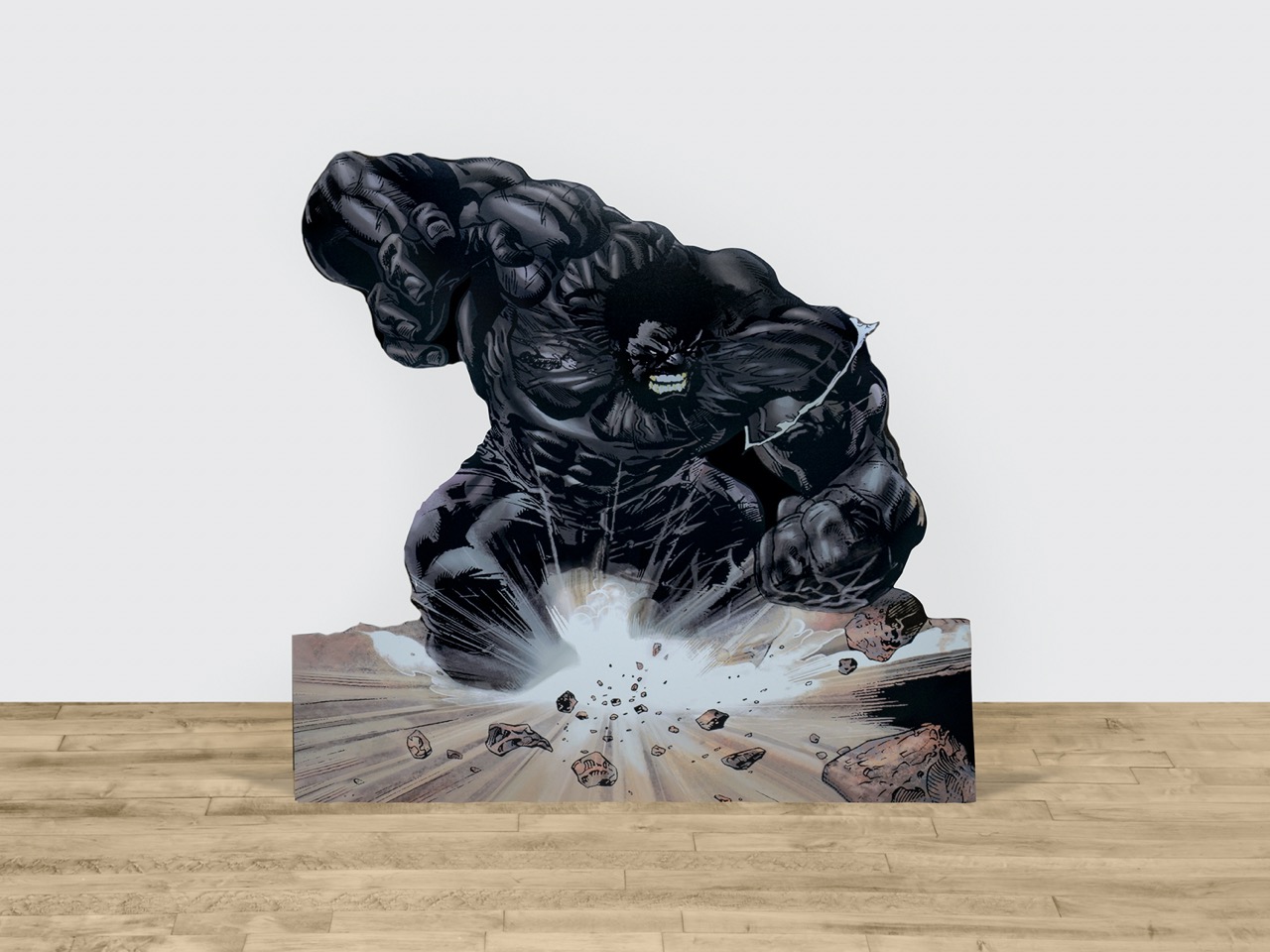
This reflection gave rise to LeRage, an almost two-metre-tall aluminium silhouette depicting a Marvel superhero: the Incredible Hulk. The character was created in 1962 by Stan Lee and illustrator Jack Kirby and has a particular backstory: Hulk is not a character in his own right, but the alter ego of scientist and physicist Robert Bruce Banner. His transformation is the result of a mutation caused by exposure to gamma radiation and occurs temporarily in moments of intense emotional tension, anger, or distress.
Hulk embodies everything that Dr Banner is not, and vice versa. While Banner is mild-mannered and thoughtful, Hulk is a large, hulking green figure driven by instinct and brute force, growing in size and muscularity in proportion to his anger. All of this takes on a different meaning when we learn that Arthur Jafa conceived LeRage as a self-portrait.
LeRage – rage – is a universal emotion that can move in two directions: it can be destructive, and this is where the punch Hulk is about to throw takes on meaning; or it can become a driving force for resisting injustice and fighting for what one believes in. It is in this second sense that the work can be read as a metaphor for a repressed anger, that of a population historically subjected to racism, which finds in the civil rights movement a means of expressing and channeling that anger into resistance.
In the work, the Incredible Hulk emerges from the ground in all his fury and power, his body black rather than green, his face and gaze distorted by rage. The image of the superhero confronts and overwhelms the viewer, almost making them fear that it might come to life and break through the fourth wall.
The choice of Hulk, among all the characters drawn from the worlds of science fiction and comics, carries considerable narrative weight: throughout the story, Banner does everything he can to avoid becoming Hulk and, when it happens, experiences a profound sense of guilt and shame. Could this sense of guilt and shame, then, evoke, by contrast, that which has been imposed upon Black people for centuries within a society shaped by racism? Jafa has stated that he has always felt “[…] born arrested or something. Arrested. Under arrest. And the art thing is the only thing I’ve done where it’s been, I don’t mean easy in the sense that I don’t have any insecurities, but I’ve never had a shortage of ideas of what to do.” Perhaps it is also through art, then, that Jafa has sought to unravel and give form to this complexity, exploring it through different languages and forms.
LeRage thus reveals a dimension of Jafa’s identity, born out of a profound process of self-awareness, almost as if it were an alter ego that he must keep under control, release when necessary, and allow to fight for what he believes in.
Arthur Jafa
LeRage, 2017
Color print on Dibond, aluminum plate stand 212 x 194.6 x 58.5 cm
Collection Maja Hoffmann / Luma Foundation
© Arthur Jafa
The artwork LeRage is currently on view in the exhibition Helter Skelter: Arthur Jafa and Richard Prince, curated by Nancy Spector, at Fondazione Prada in Venice, from March 10 to November 23, 2026.
26/09/26