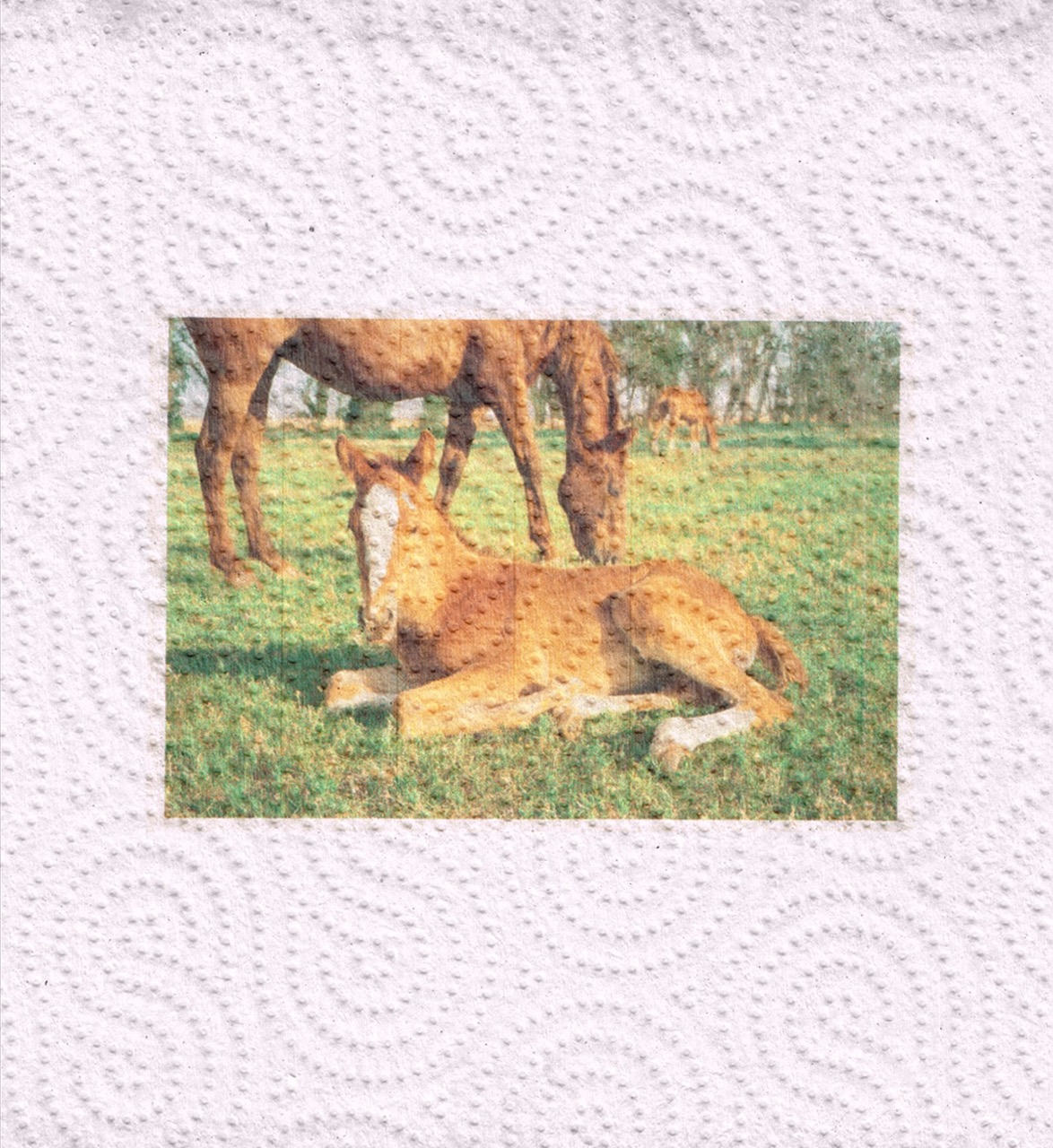
Argentinian photographer Inés Vidart’s experimental practice explores the unique possibilities of photographic printing by extending it beyond the conventional supports traditionally associated with the medium. Coming from a background in editorial design, where she worked primarily with digital images, Vidart felt the need to engage with the analog process. Within this approach, the materiality of the image becomes fundamental, emerging as an integral part of the visual experience. The surface that carries the image is no longer a neutral support but a communicative medium in its own right, capable of conveying meaning alongside the photographic subject itself.
This exploration is embodied in Fibra Abierta, a series of photographs produced through both analog and digital processes in the rural landscapes of Córdoba, Argentina. The works depict the local flora and fauna—cultivated fields, horses, and cattle that inhabit them. What distinguishes the series, however, is its unconventional printing surface: paper napkins. The fibrous texture and woven patterns of the material permeate the images, becoming an essential component of their visual construction. In one of the photographs, a horse lies in the foreground on the grass while, in the distance, other horses graze peacefully in the meadow. The vivid greens of the vegetation and the rich brown tones of the animals’ coats stand out in striking contrast against the white of the paper. The napkin creates a natural frame around the image that both enhances its visual presence and softens its boundaries, as the paper’s texture flows seamlessly across both the support and the photograph itself.
The use of such an everyday material is far from incidental; rather, it forms the conceptual starting point of Vidart’s research. The paper napkin, a material inherently fragile and ephemeral, becomes the support for a photographic print, assuming an unexpected sense of permanence in the service of preserving the image.
In doing so, Vidart challenges conventional assumptions about both photography and its physical support, prompting a reflection on the preservation of memories and lived experiences, as well as on the ways they are transmitted over time. Her works mirror the gradual deterioration of memory itself, understood not as a fixed archive but as a fragile and ever-evolving construct, continuously reshaped by the passage of time.
© Inés Vidart, Fibra Abierta, 2026
35mm & digital photographs, inkjet print on paper napkin, 18×18cm.
15/07/26